Practical guides to AI, computing, modelling, simulation, optimization and quantum computing, featuring hands-on tutorials, experiments and research.

Quantum Fourier Transform (QFT) of a Single Qubit is Hadamard Transform

Part of the Quantum Computing: A Complete Learning Path series.

Below is the definition of QFT as illustrated in the YouTube lecture by Abraham Asfaw.

The LaTex code for the equation is as follows and also available here.

Latex
| \tilde{x} \rangle \equiv ~ QFT ~ |x \rangle ~ \equiv \frac{1}{\sqrt{N}}\sum_{y=0}^{N-1}{e^{\frac{2\pi ix y}{N}}} ~| y \rangle

For the one qubit case, N = 21 = 2:
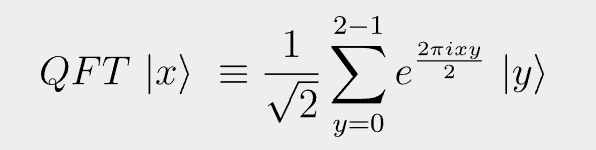
Latex
| \tilde{x} \rangle \equiv ~ QFT ~ |x \rangle ~ \equiv \frac{1}{\sqrt{}N}\sum_{y=0}^{N-1}{e^{\frac{2\pi ix y}{N}}} ~| y \rangle

Latex
\frac{1}{\sqrt{2}}\sum_{y=0}^{1}{e^{\pi ix y}} ~| y \rangle = \frac{1}{\sqrt{2}}[~e^{i \pi x 0}~ | 0 \rangle ~ + ~ e^{i \pi x 1}~| 1 \rangle] = \frac{1}{\sqrt{2}}[~|0\rangle ~+~e^{i \pi x}~|1 \rangle~]

When x = 0:

Latex
QFT~| 0 \rangle = \frac{1}{\sqrt{2}}[~|0\rangle ~+~e^{i \pi 0}~|1 \rangle~] = \frac{1}{\sqrt{2}}[~| 0 \rangle + |1 \rangle~] = |+\rangle

When x = 1:


Latex
QFT~| 1 \rangle = \frac{1}{\sqrt{2}}[~|0\rangle ~+~e^{i \pi 1}~|1 \rangle~] = \frac{1}{\sqrt{2}}[~| 0 \rangle - |1 \rangle~] = |-\rangle

Hence the QFT of a single qubit is essentially the Hadamard transform.

Frequently Asked Questions

Is the QFT of one qubit the same as the Hadamard gate?

Yes. Working through the N=2 case of the QFT formula shows QFT|0⟩ = |+⟩ and QFT|1⟩ = |−⟩, which are exactly the outputs of a Hadamard gate on the same inputs. For a single qubit, QFT and H are literally the same operation.

What is the Quantum Fourier Transform used for?

It’s a core subroutine in algorithms like Shor’s factoring algorithm and quantum phase estimation, where it converts information encoded in the phase of a quantum state into a form that can be read out by measurement in the computational basis.

Why does QFT|0⟩ give |+⟩ and QFT|1⟩ give |−⟩?

Substituting x=0 into the one-qubit QFT formula makes the phase term e^(iπx) equal 1, giving (|0⟩+|1⟩)/√2 = |+⟩. Substituting x=1 makes e^(iπx) equal −1, giving (|0⟩−|1⟩)/√2 = |−⟩ — the same sign flip a Hadamard gate produces on |1⟩.

Continue the Quantum Series

Comments

One response to “Quantum Fourier Transform (QFT) of a Single Qubit is Hadamard Transform”

  1. Quantum Computing: A Complete Learning Path – Techucation Avatar

    […] and why tensor products scale the state space. 2  ·  The Hadamard Toolkit 2 The Quantum Fourier Transform of a Single Qubit is the Hadamard Transform The one-qubit QFT turns out to be exactly the Hadamard gate, a small result that anchors the bigger […]

    Like

Leave a comment